GENERAL OVERVIEW
Tripartite Escrow Agreements may provide a valuable mechanism for small business contractors seeking to participate in federal procurement opportunities. In many instances, small contractors are unable to submit proposals, bids, or offers to federal agencies and departments due to payment security and performance assurance requirements. Such limitations not only restrict competition but also deprive the Government of the benefits associated with contracting with small businesses, including individualized attention, expedited response times, operational flexibility, and reduced costs. Consistent with the objectives of the Federal Acquisition Streamlining Act of 1994, Public Law 103-355, Tripartite Escrow Agreements may serve as an alternative payment protection arrangement designed to facilitate greater participation by qualified small business contractors in federal contracting opportunities.
Tripartite Escrow Agreements are expressly recognized under federal procurement regulations as an alternative form of payment protection for certain federal construction contracts with a value not exceeding $150,000. The authorization of such agreements is intended to promote increased participation by small business contractors in federal contracting while providing Government agencies with access to a larger and more competitive pool of qualified contractors.
In accordance with the Federal Acquisition Regulation (“FAR”), including FAR 28.102-1 and FAR 52.228-13, a Tripartite Escrow Agreement may be accepted, where authorized, in lieu of traditional payment protection requirements. This regulatory framework was established to facilitate competition, reduce barriers to entry for small contractors, and further the Government’s interest in obtaining quality services at competitive prices.
For a complete review of the applicable regulatory provisions governing Tripartite Escrow Agreements, including FAR 28.102-1 and FAR 52.228-13, please select the corresponding links or buttons provided below.
“The prime contractor establishes an escrow account in a federally insured financial institution and enters into a tripartite escrow agreement with the financial institution, as escrow agent, and all of the suppliers of labor and material. The Tripartite Escrow Agreement shall establish the terms of payment under the contract and of resolution of disputes among the parties. The Government makes payments to the contractor’s escrow account, and the escrow agent distributes the payments in accordance with the agreement, or triggers the disputes resolution procedures if required.”
PAYMENT PROTECTION OPTIONS
A contractor now has five (5) alternative payment protection options, per Federal Acquisition Regulation Part 28 Section 102 the options are as follows:
1. Payment bond.
2. An irrevocable letter of credit.
3. A certificate of deposit.
4. Other deposits for the type of security listed in FAR 28.204-1 and FAR 28.204-2.
OPTION #5
Tripartite Escrow Agreement (Federal Contracts Not Exceeding $150,000)
Pursuant to FAR § 28.102 and other applicable provisions of the Federal Acquisition Regulation, a Tripartite Escrow Agreement may be accepted by the Government as an alternative form of payment protection in lieu of a payment bond or other authorized payment protection mechanisms for eligible federal contracts not exceeding $150,000.
A Tripartite Escrow Agreement provides contractors with a legally recognized method of satisfying applicable payment protection requirements while avoiding many of the financial and administrative burdens associated with traditional surety and collateral-based instruments. The fee for a Tripartite Escrow Agreement is generally limited to two percent (2%) of the contract value.
Unlike conventional payment bonds, irrevocable letters of credit, or certificates of deposit, qualification for a Tripartite Escrow Agreement may not require the submission of financial statements, tax returns, proof of working capital, or evidence of prior contracting experience. Accordingly, the use of a Tripartite Escrow Agreement may facilitate greater participation by small business contractors and other qualified entities that might otherwise be unable to satisfy traditional bonding or collateral requirements.
Where expressly authorized by the solicitation or contracting officer, a Tripartite Escrow Agreement may provide a compliant, efficient, and cost-effective means of meeting federal payment protection obligations while preserving contractor liquidity and reducing transactional costs.
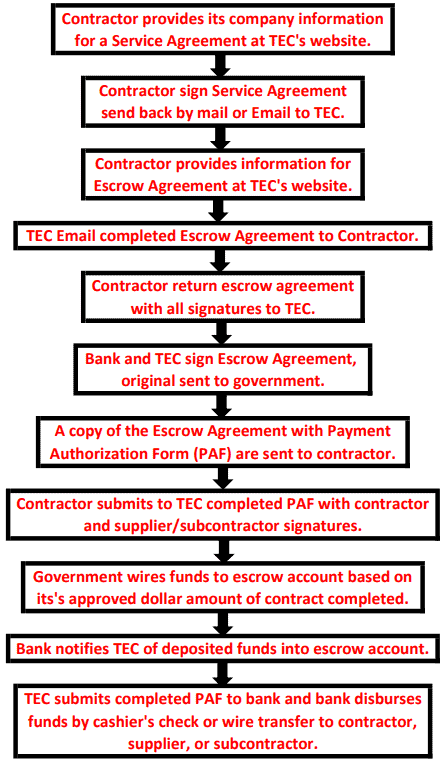
The following is the Escrow Process.